
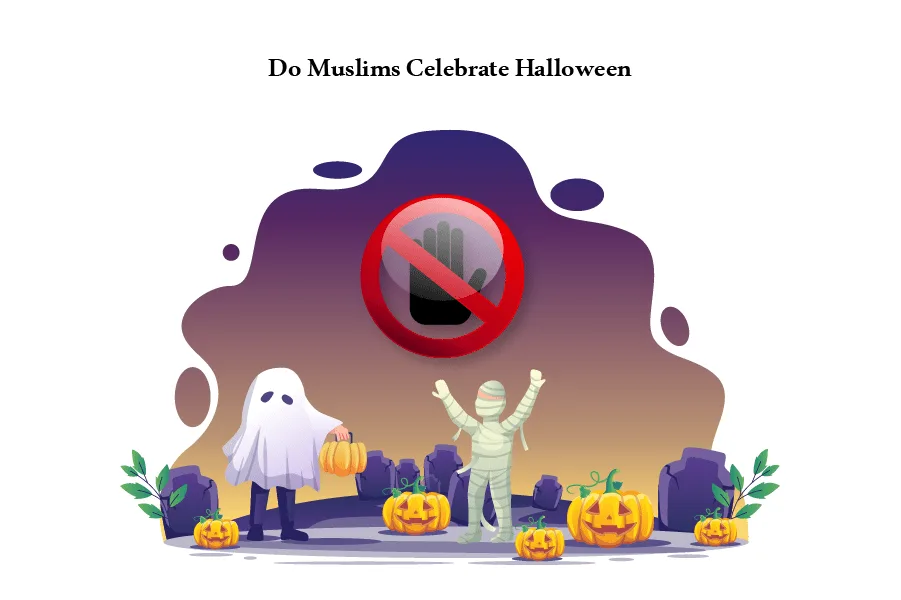
Halloween is fast approaching in the West, and children and families often ask, “ Can Muslims celebrate Hallowen?”
Every year in October, the Hallowen festivities tend to become more tempting for children. Shiny displays at stores are extensively decorated with Hallowen-themed decorations and candies. Stuff from spooky costumes, witches’ masks, ghosts, skeletons, lanterns, and special edition candies fill the place. Besides, Hallowen adventures and entertaining events are advertised.
The media frenzy and commercial propaganda make it harder for our little children to resist the allurement. Halloween is the second most profitable holiday after Christmas in the United States. In 2018, the US retail spending on Hallowen was $ 9 billion, of which $ 2 billion was spent on costumes.
To understand why Muslims Shouldn’t celebrate Hallowen, We must be mindful that there’s more to Hallowen than innocent fun.
The origin of Halloween
Hallowen originated more than 2000 years ago from the ancient Celtic pagans. They lived in Ireland, Scotland, Wales, the Isle of Man, Cornwall, and Britain, also known as the Celtic nations. Hallowen symbolizes the beginning of the ancient Celtic New Year.
On October 31st, Samhain, which means ‘Summer’s end,’ was an important festival celebrated by the Celtic people. They believed that this festival – the end of summer and the beginning of the cold season- honoured the Lord of the death.
The Celtics believed that the Lord of death called the dead spirits to visit the world on the eve of the Samhain Festival. The Celtics offered the dead spirits treats and gifts to please them. It was a pagan belief that if the wicked spirits were pleased with their offerings, they would leave the Celtics to live in peace. However, if they are dissatisfied with their gifts, they will cast their spell on them.
Is it Haram to celebrate Halloween?
After the Romans conquered Britain, and with the spread of Christianity, ‘Samhain’ was changed to ‘Hallowmas’ or ‘All Saints day’ or ‘All Souls day.’ It is observed on November 1st to honour all saints in heaven.
Today people celebrate Hallowen in a way that is a hybrid of both celebrations, the Samhain and Hallowmas. By the time the corporate world has added its additions to turn it into a profitable commercial occasion.
Can Muslims Celebrate Halloween
Muslims do not believe that the dead or their ghosts come back to life, visit the Earth, or have any power over us. We don’t think we should fear their spell or wear costumes and light bonfires to keep the wicked spirits away.
We believe in the unity of God and His power. Hallowen has no spiritual meaning, no matter how deep we dig. Its message is all about witches and satanic worship.
It is incredibly wrong to believe in supernatural things, even for fun.
Allah says in the Holy Quran
وَالَّذِينَ لَا يَشْهَدُونَ الزُّورَ وَإِذَا مَرُّوا بِاللَّغْوِ مَرُّوا كِرَامًا
And those who do not witness falsehood, and if they pass by some evil play or talk, die by it with dignity.
Al-Furqan 25:72
What do scholars say about Muslims that celebrate Halloween?
According to renowned Islamic scholars and Mufassireen like Ibn Kathir, the word “Falsehood” or “Zoor” (زور) in the above Ayah can be of different types. Even though the highest level of (زور) Falsehood is Kufr and Shirk, other situations that also fall under this category of falsehood are places where Shirk, Kufr, dancing, music, drinking, ba3`ck-biting, false accusations, and celebrations of Mushrikeen is taking place.
The above Ayah explains that Allah’s faithful servants should try and refrain from such gatherings, and if they happen to be there, they should leave the scene right away with dignity coming out clean and pure.
Abdullah ibn Umar narrated that the Prophet (ﷺ) said:
مَنْ تَشَبَّهَ بِقَوْمٍ فَهُوَ مِنْهُمْ
“Whoever imitates a people is one of them.”
{Hasan Sahih (Al-Albani)}
Finally, as Muslims and parents, we must understand the origin behind Western celebrations. We need to be mindful to teach our children that we respect others’ traditions without compromising our own beliefs, values, and faith.
5 FAQs About Halloween Commonly Asked by Muslims in America
1. Is it permissible for Muslims to celebrate Halloween?
From an Islamic perspective, many scholars discourage participating in Halloween as it is rooted in pagan and Christian traditions and often involves practices that conflict with Islamic beliefs, such as superstitions and glorifying symbols of death. Instead, families are encouraged to focus on Islamic alternatives or educational activities.
2. How can I explain to my children why we don’t celebrate Halloween?
You can teach your children about the Islamic perspective on cultural celebrations and explain that while we respect others' traditions, Muslims have their own special days, like Eid. Offer fun, faith-based alternatives to make them feel included, such as hosting a family gathering or a special outing.
3. Can Muslim children go trick-or-treating with their friends?
Many scholars advise against trick-or-treating because it aligns with Halloween's cultural and historical practices. However, some Muslim families choose to participate in a limited way, focusing on the social aspect while avoiding un-Islamic elements. It is ultimately a personal choice based on your understanding and values.
4. Are there halal alternatives to Halloween activities?
Yes, some Muslim families and communities organize halal alternatives, such as themed gatherings, storytelling events, or charity drives during Halloween. These activities allow children to enjoy socializing and creativity without compromising Islamic principles.
5. How can we interact respectfully with neighbors on Halloween?
If you choose not to participate in Halloween, consider leaving a friendly note on your door explaining your stance. Alternatively, some families give out candy with a positive Islamic message, fostering goodwill while staying true to their beliefs. Being kind and respectful reflects the Islamic values of good neighborliness.