
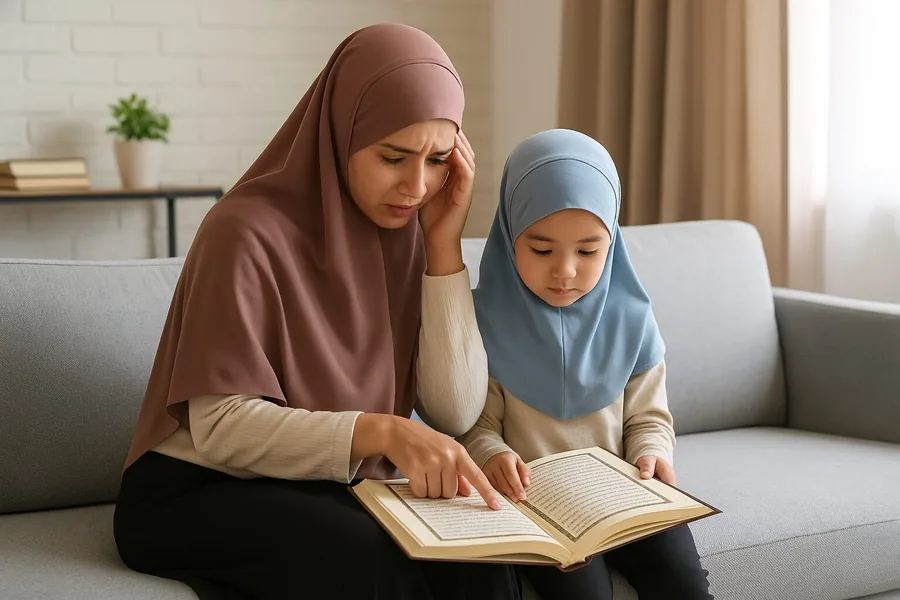
Moms teaching Quran : Every Muslim mom carries a quiet dream in her heart: to raise children who love the Quran, not just read it. For mothers living in the USA, Canada, UK, or Australia, this dream comes with its own set of challenges. Between school schedules, extracurriculars, and the digital distractions of modern life, moms teaching Quran at home often feel like they’re walking an uphill road—one that’s filled with guilt, exhaustion, and countless “Ammi, not now!” moments.
The truth is, moms teaching Quran in Western countries face unique struggles that others may not see, yet their effort speaks of love and resilience. Despite the hurdles, moms teaching Quran remain the backbone of faith education in countless homes, quietly carrying a responsibility that is both beautiful and heavy.
You are not alone in this. Many Muslim mothers across the world are trying to juggle parenting, housework, and faith education, and silently carrying the weight of being their child’s first Quran teacher. Let’s uncover the struggles that rarely get spoken about and explore how online Quran classes can become a lifeline for today’s Muslim families.
The Emotional Weight No One Talks About
Moms teaching Quran at home don’t just teach letters and Surahs—they carry the responsibility of preserving faith within their families. That’s heavy. When children resist, get bored, or roll their eyes, the guilt feels crushing. Mothers worry:
- “Am I failing as a parent?”
- “What if my child never connects with the Quran?”
- “Do I even know enough to teach properly?”
These thoughts can quietly eat away at confidence. For many moms, the hardest part isn’t the recitation itself—it’s the emotional tug-of-war between wanting to be a loving mother and the pressure of being the family’s religious guide.
The Language Barrier: Arabic Meets English
For families in the West, Arabic isn’t always the home language. This creates unique challenges. Moms might know how to recite but stumble when kids ask questions like:
- “Why is this letter read differently here?”
- “What does this word mean in English?”
When children grow up surrounded by English, Urdu, or Somali, Quran learning can feel distant. Moms teaching Quran at home often wish they had stronger Arabic skills, but the reality is: it’s not easy to explain Tajweed in a child’s first language.
This is where online Quran learning steps in. Professional teachers who are fluent in Arabic and English can bridge the gap, ensuring kids don’t just parrot sounds but actually connect with meaning.
Time Battles: Quran vs School, Sports, and Netflix
A typical weekday for many Muslim families in the USA or UK looks like this: school drop-off, after-school activities, homework, dinner, and finally… Quran time. By then, everyone is exhausted. Children want cartoons or video games. Moms want a break.
The result? Quran becomes just another “task” to squeeze in. No wonder kids resist.
Online Quran classes solve this by offering flexible schedules. Instead of forcing Quran between math homework and bedtime, parents can book classes at the time that works best for their child. Whether it’s early mornings in Australia, after school in Canada, or weekends in the UK, online learning adapts to family life instead of competing with it.
The Confidence Gap: “Am I Enough?”
Many moms quietly compare themselves to madrassa teachers or professional scholars. They replay mistakes in their head—pronouncing a letter slightly off, forgetting a Tajweed rule—and feel inadequate.
The truth is, mothers aren’t meant to carry this role alone. Your job isn’t to be the perfect teacher; it’s to nurture love for the Quran. Professional teachers can handle technical accuracy, while you provide encouragement and emotional support.
Think of it this way: when your child goes to school, you don’t feel guilty for not being a math expert. Quran learning can work the same way—you guide the values, while trained teachers guide the recitation.
When Kids Push Back
Every mom teaching Quran has faced the dreaded words: “I don’t want to do this.” Sometimes kids argue, sometimes they sulk, sometimes they simply close the mushaf and refuse.
It’s painful, because it feels personal. But often, resistance comes from boredom. To children, Quran lessons at home can feel repetitive—especially if they’re taught in the same tone, at the same time, with little variety.
Online Quran learning changes the dynamic. Teachers bring games, stories, and interactive screens. Some use visual aids or storytelling to explain verses. This makes lessons feel exciting, not like extra homework.
The Mom vs Teacher Balance
Perhaps the hardest struggle for many mothers is the blurred role between being a nurturing parent and becoming the disciplinarian teacher. Every mom wants her child to associate the Quran with love, comfort, and peace. But when daily Quran sessions turn into battles—reminding, correcting, scolding—the warmth of motherhood can begin to feel overshadowed by the pressure of being “the teacher.”
This role conflict often leaves moms feeling torn. On one hand, they want to be patient and gentle, but on the other hand, they feel responsible for ensuring their child’s recitation is correct. When kids resist, argue, or lose focus, moms are forced into a stricter tone, one they never intended to use when it comes to the Quran. Over time, this can unintentionally create tension in the relationship. Children may begin to see Quran time as a moment of stress rather than a source of joy, which is heartbreaking for any mother who only wants the best for her child.
Outsourcing Quran instruction to a qualified teacher doesn’t mean a mom is stepping back—it actually means she’s protecting the beauty of her bond with her child. By allowing someone else to take the role of the “Quran teacher,” mothers preserve their natural place as the source of love, encouragement, and emotional safety. The teacher becomes the one who sets structure, corrects mistakes, and manages discipline, while the mother remains the cheerleader—the person who celebrates every Surah learned and every small milestone achieved.
This separation of roles helps children experience the Quran as something positive and exciting, while also helping moms avoid burnout. In fact, many mothers who switch to online Quran classes notice that their relationship with their children becomes warmer during Quran time. Instead of being remembered as the “mom who scolds me when I mispronounce,” they become the mom who listens, smiles, and supports. That’s a priceless shift.
How Online Quran Learning Lightens the Load
Here’s how online Quran classes can transform the struggles of moms teaching Quran:
- ✅ Qualified teachers – Experts in Tajweed and Arabic, fluent in English.
- ✅ Flexible scheduling – Fits around school, work, and family life.
- ✅ Engaging methods – Games, visuals, and stories that grab kids’ attention.
- ✅ Female teachers – For comfort and cultural familiarity.
- ✅ Global reach – Whether you’re in the USA, UK, Canada, or Australia, you can access the best teachers worldwide.
Most importantly, online Quran learning gives moms breathing space. Instead of carrying everything, you share the journey with skilled teachers.
Real Stories from Moms
- Fatima from Toronto tried for six months to teach her son Surah Al-Baqarah. He resisted every night. When she switched to online Quran classes, he began looking forward to lessons because his teacher used digital whiteboards.
- Ayesha in London worried her daughter’s accent was affecting her Tajweed. Online lessons helped correct her pronunciation gently, without straining their relationship.
- Mariam in Sydney is a homeschooling mom. Online Quran learning allowed her to focus on other subjects while ensuring her kids stayed consistent with Quran.
Final Thoughts: Moms Don’t Have to Do It Alone
Dear mothers, your effort in teaching Quran at home is already an act of worship. Allah sees the late nights, the repeated corrections, the tears of guilt. You don’t have to be perfect—you just have to care, and you already do.
The secret is: you don’t need to carry this burden alone. With online Quran classes, you can give your children professional guidance while keeping your relationship with them rooted in love, not conflict.
If you’re a mom teaching Quran at home in the USA, Canada, UK, or Australia, take the next step: Start your free trial of online Quran classes today.
Let experts guide your children’s recitation, while you focus on nurturing their love for the Quran.