
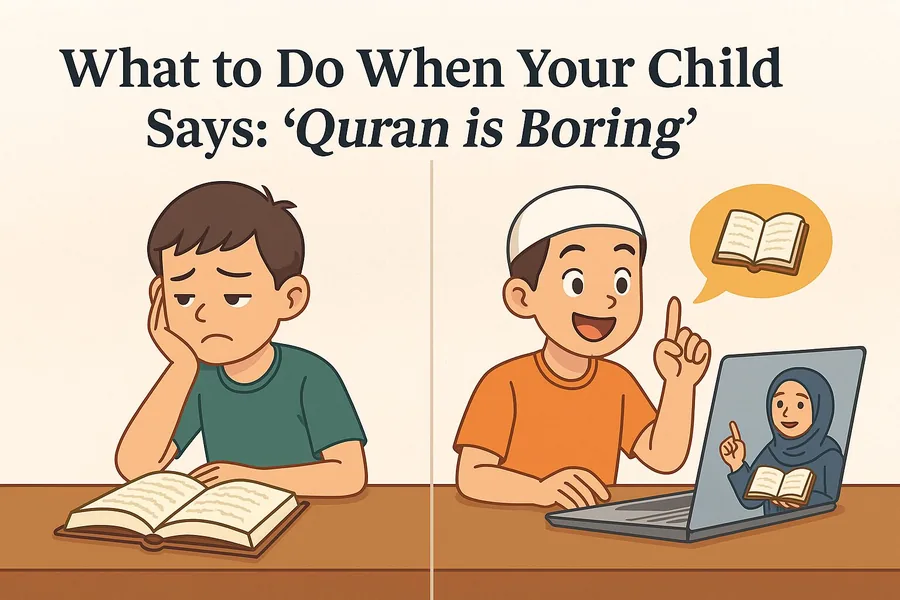
Hearing your child say “Quran is boring” can feel like a dagger to the heart. As parents, we know the Quran is the most beautiful and life-giving guidance from Allah ﷻ. But in a world where cartoons sing, video games flash, and social media never stops, the stillness of a Quran lesson can sometimes lose the competition. The good news? Boredom isn’t rejection—it’s a signal. And by understanding why children feel this way, we can turn “Quran is boring” into “Quran is exciting, meaningful, and mine.”
Why Kids Say “Quran is Boring”
1. Competing With Digital Stimulation
Children today are “digital natives.” Studies show the average child spends 5–7 hours daily on recreational screen time . Their brains are constantly rewarded with quick dopamine hits from TikTok clips, video games, and YouTube videos. Compared to that, sitting still to repeat verses feels slow and unrewarding. It’s not that the Quran is boring, it’s that the environment has rewired their expectations of “fun.”
2. Lack of Understanding
A 2019 Pew Research study found that Muslim parents in the West often emphasize recitation before comprehension. While this preserves Tajweed, children may feel they’re just chanting sounds they don’t understand. Research in child learning shows that engagement skyrockets when kids understand the “why” behind what they’re learning . Without meaning, even the most melodious recitation can feel empty to a child.
3. Traditional Teaching Gaps
Traditional classrooms often involve group repetition, with little room for interaction. But neuroscience reveals that kids learn best when lessons are interactive, story-driven, and multisensory . If Quran learning feels like homework, children disengage.
How to Transform “Quran is Boring” into “Quran is Exciting”
1. Make Quran Learning Interactive
Research in child education shows interactive learning (using visuals, games, and digital tools) increases retention and motivation by up to 60% compared to passive methods. Online Quran classes often use screen-sharing, digital whiteboards, and quizzes—turning lessons into something that feels closer to a game than a lecture.
Example: A child can trace Arabic letters on-screen with their teacher, hear instant feedback, and celebrate each correct sound. Suddenly, learning Quran isn’t boring—it’s dynamic and fun.
2. Teach Through Stories
Children love stories. Developmental psychology confirms that storytelling enhances memory and emotional connection. The Quran itself teaches through stories—of Prophets, nations, and moral lessons. Presenting Surah Yusuf as “the most beautiful story,” or turning the bravery of Musa (AS) into an adventure, sparks curiosity.
Try connecting Quran verses with themes they already enjoy: courage (like superheroes), patience (like athletes), or justice (like their favorite heroes in movies).
3. Relate Quran to Daily Life
Research in moral development shows children retain values better when they see practical applications. Instead of abstract recitation, link verses to their lived experiences:
- “When you share your toys, you’re living the Quranic value of generosity.”
- “When you say Bismillah before eating, you’re following Allah’s guidance.”
When children realize the Quran speaks to them, it no longer feels boring—it feels alive.
4. Embrace Technology—Not Fight It
Parents often fear screens, but experts remind us that not all screen time is harmful. Educational screen time, like online Quran classes, can transform a child’s relationship with learning . Kids who live online already feel comfortable navigating Zoom, apps, and interactive videos. Meeting them where they are makes Quran study natural instead of forced.
5. Celebrate Small Wins
Studies in motivation psychology show that celebrating small achievements builds momentum. If a child learns one verse, cheer for it. If they master Tajweed for a letter, reward them. This creates a cycle of excitement and confidence rather than dread.
Why Online Quran Classes Work Best for Modern Kids
In a world where children are growing up surrounded by digital distractions and fast-paced media, the traditional methods of Quran teaching sometimes struggle to hold their attention. That’s where online Quran classes stand out—they’re designed to match the learning styles, routines, and interests of today’s children. Rather than forcing kids to adapt to outdated methods, platforms like AlQuranClasses bring the Quran into their world in a way that feels natural, engaging, and even exciting.
Here’s why parents are increasingly choosing this path:
1. Interactive Learning That Captures Attention
Modern kids thrive on visuals, interactivity, and immediate feedback. Online Quran classes use tools like shared digital whiteboards, engaging quizzes, story-based lessons, and colorful visuals to make learning memorable. Instead of passively repeating after a teacher, kids actively participate—clicking, reading, answering, and engaging with the material. This approach taps into the same curiosity that keeps them hooked on games or YouTube, but channels it toward the Quran.
2. One-on-One Focus That Builds Confidence
In large madrasa or weekend school settings, many children feel invisible or overlooked. Online classes solve this by offering one-on-one or very small group sessions. Every child gets the teacher’s full attention, ensuring mistakes are corrected gently, questions are answered, and progress is personalized. Shy children who may hesitate to speak up in a crowded classroom often blossom in the comfort of individualized lessons. Parents frequently note that their children become more confident and excited about reciting once they have a teacher dedicated just to them.
3. Flexible Schedules That Fit Busy Lives
Between school, homework, extracurricular activities, and family commitments, many Muslim parents in the USA, Canada, UK, and Australia find it nearly impossible to stick to rigid Quran class timings. Online Quran classes are built with flexibility in mind. Parents can schedule sessions at times that work best—whether early mornings before school, afternoons, or weekends. No rushing through dinner, no long commutes, no missed lessons. This flexibility makes consistency possible, and consistency is the key to real Quranic progress.
4. Understanding Before Memorization
One of the reasons some kids lose interest in Quran learning is that they feel they are memorizing without meaning. Online Quran teachers at AlQuranClasses prioritize explaining the “why” alongside the “what.” When children understand the stories behind verses or the values embedded in them—patience, kindness, honesty—they realize that the Quran isn’t just words; it’s a guide for their own lives. This deeper connection transforms learning from a chore into a source of inspiration.
5. A Safe and Supportive Environment
For parents raising children in the West, safety and comfort are huge concerns. Online classes allow children to learn in their own homes under parental supervision. This creates a secure environment where parents know exactly who their child’s teacher is and can easily observe progress. Children, too, feel more relaxed learning from home, which improves focus and retention.
6. Turning Boredom into Excitement
Perhaps the biggest benefit is the change in attitude. Parents around the world report the same transformation: children who once dragged their feet to Quran class or complained that “Quran is boring” now eagerly log in to their online lessons. With the right teacher, engaging methods, and a personalized pace, the Quran becomes something they look forward to, not something they dread.
Conclusion: From Boredom to Belonging
When your child says “Quran is boring,” don’t panic. It’s not rejection—it’s an invitation to rethink the approach. Children thrive when Quran learning is interactive, story-driven, and connected to their lives. By blending tradition with modern methods like online classes, we can nurture a generation that not only recites the Quran but loves it.
Instead of forcing them into silence, give them the gift of engagement. Because the Quran was never boring—it was always alive. We just need to show them how.
👉 Ready to make Quran learning exciting for your child? Start a free trial with AlQuranClasses today. Let’s replace boredom with love for the Book of Allah.