
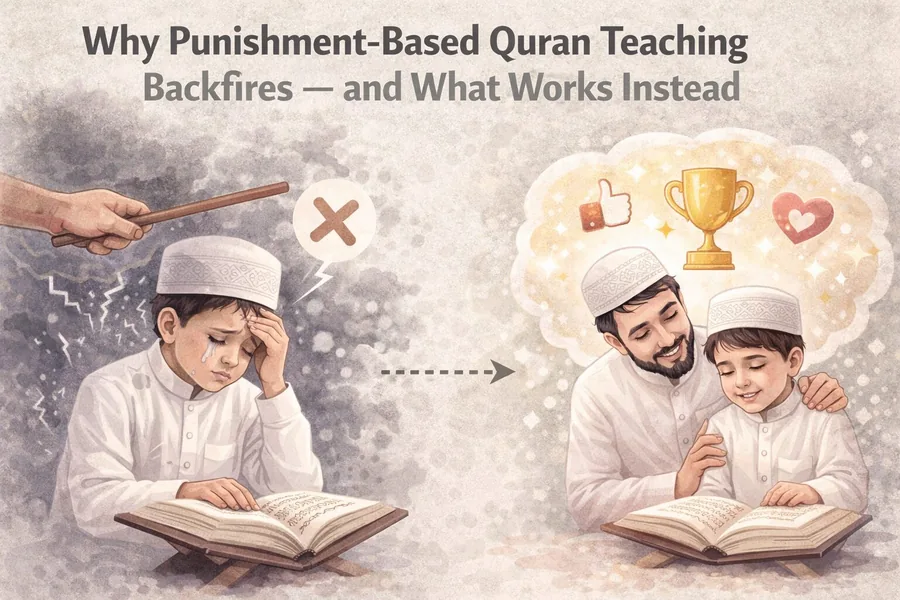
Many Muslim parents grew up with a very strict style of Quran learning. Maybe mistakes were met with shouting. Maybe missed lessons led to threats. Maybe a child was compared, embarrassed or punished for forgetting an ayah. So when parents see their own child struggling with recitation, Tajweed, memorization or focus, they may repeat the same method without realizing the damage it can cause.
But punishment-based Quran teaching often backfires. Instead of helping children love the Quran, it can make them afraid of it. Instead of building discipline, it can create resistance. Instead of improving recitation, it can make a child nervous, ashamed and less willing to try. The goal isn't to remove structure — it's to teach the Quran with firmness, patience, mercy and emotional wisdom.
What Is Punishment-Based Quran Teaching?
Punishment-based Quran teaching is any approach where fear, shame, threats or harsh consequences become the main tools for making a child learn. It may look like scolding harshly for mistakes, threatening a child for forgetting a lesson, comparing them to siblings, withdrawing affection when they don't perform well, embarrassing them in front of others, or making Quran time a daily battle. Parents may not intend harm — many are simply worried. But when fear becomes the foundation, the child learns the wrong lesson. They may not think “Quran is beautiful.” They may think “Quran time is when I get in trouble.”
Why Punishment-Based Quran Teaching Backfires
Children learn best when they feel safe enough to try, make mistakes and improve. Quran learning requires repetition, correction, listening, pronunciation practice and confidence — and a nervous child often struggles more. When this approach is used repeatedly, a child may associate the Quran with stress instead of love. They may avoid lessons, pretend to practice, recite quickly just to finish, hide mistakes, cry before class, or come to believe they're “not good at Quran.” This is the opposite of what parents want. The Quran is meant to be guidance, healing, mercy and light — the way we teach it should not make a child feel crushed.
Fear May Create Short-Term Obedience, But Not Long-Term Love
Punishment can produce quick results — a child may sit still because they're scared, or memorize for a test because they fear consequences. But short-term obedience isn't the same as lifelong connection. A child who learns only through fear may stop as soon as the pressure is removed. When they're older and parents can no longer force them, they may avoid the Quran completely. That's one of the biggest dangers of punishment-based Quran teaching: it makes learning depend on external pressure rather than internal love and connection.
The Hidden Emotional Cost
Some children don't openly rebel — they keep attending class, but inside they feel anxious or disconnected. They may think “I always make mistakes,” “My parents are disappointed in me,” or “I will never be good at this.” Over time these feelings damage confidence, and a child who feels ashamed may stop trying because effort feels risky. Look beyond whether the child is “doing the lesson” and ask: Does my child feel safe learning Quran? Do they believe improvement is possible? Do they connect the Quran with peace or with pressure?
Mistakes Are Part of Quran Learning
Children will forget, mispronounce letters, mix up ayahs, lose focus and need reminders. This doesn't mean they're careless or disrespectful — it means they're learning. A healthier environment treats mistakes as part of the process. Correction still matters, especially with Tajweed, but it doesn't need to humiliate. Instead of “You keep getting this wrong!” try “Let's slow down and fix this letter together.” Instead of “How many times have I told you?” try “This part needs more practice. We'll repeat it step by step.” This kind of correction builds confidence instead of fear.
What Works Instead: Positive Discipline
The opposite of punishment-based Quran teaching isn't chaos — it's positive discipline. You still have expectations, routines and accountability, but you teach through encouragement, consistency and respect. For example: set a regular Quran time, keep lessons short and realistic, praise effort rather than just perfect recitation, use gentle correction, give breaks when a child is overwhelmed, celebrate small improvements, stay calm when mistakes happen, and follow up consistently without threats. This teaches children that Quran learning is serious, but not scary.
Build a Quran Routine That Feels Possible
Many conflicts happen because the routine is too heavy. A child comes home from school tired, with homework, dinner, activities and screen temptation — then is expected to do a long Quran session with perfect focus. For many children that's unrealistic. Make it manageable: ten minutes of review daily, one short lesson after Maghrib, listening to Quran in the car, a small weekly memorization goal, or online classes at a calm time of day. A child is more likely to cooperate when the routine feels possible. Consistency matters more than intensity.
Use Encouragement That Actually Helps
Encouragement isn't empty praise — it means noticing real effort and progress: “You read that line more smoothly today.” “I like how you tried again after the mistake.” “You remembered more than yesterday.” “I'm proud of your patience.” This helps children see learning as a journey and believe “I can improve.” For a child who has experienced punishment-based Quran teaching, encouragement may feel new at first — be patient; it may take time for them to trust that Quran time is safe again.
Choose a Teacher Who Understands Children
A good teacher does more than correct recitation — they understand how children learn. For North American Muslim families this matters especially, since children may already feel different at school or disconnected from Arabic. Look for a teacher who corrects gently, keeps lessons structured, encourages questions, adjusts pace when needed, understands Tajweed without harshness, communicates with parents, and builds confidence.
How AlQuranClasses Can Help
At AlQuranClasses, our teachers are chosen for exactly this balance — structured, accurate teaching delivered with patience and encouragement. One-to-one online classes let a child learn without fear of being shamed in front of a group, at a pace that fits them, with a teacher who corrects kindly. Many parents who once experienced punishment-based learning themselves are relieved to give their children a gentler path — one that builds a lasting love for the Quran rather than fear of it.