
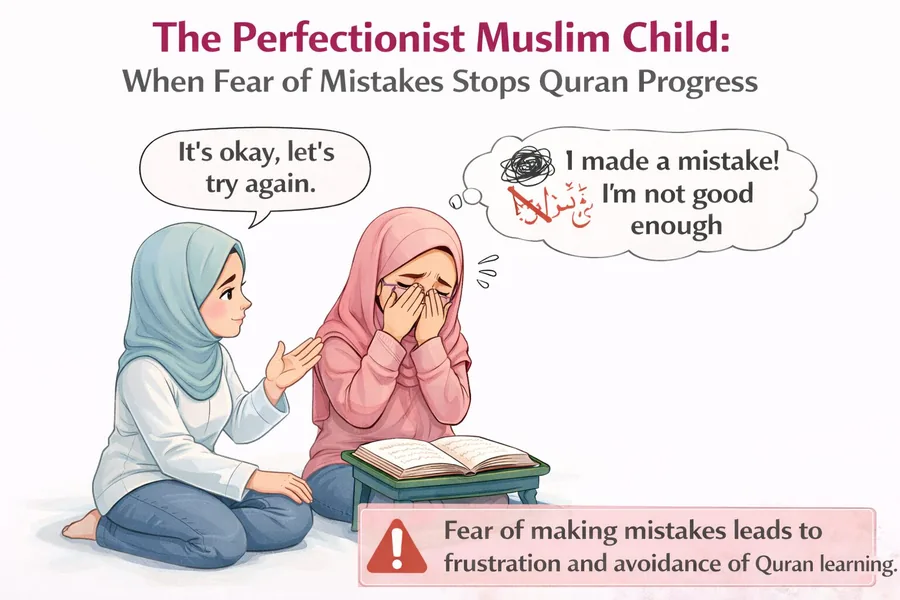
Some children don't avoid the Quran because they're lazy. They avoid it because they're afraid of getting it wrong. They may freeze before reciting, cry after one mistake, erase the same Arabic letter again and again, or say “I can't do it” before even trying. They compare themselves to siblings, worry about disappointing their parents, or feel embarrassed when corrected.
This is often the struggle of a perfectionist Muslim child. For North American Muslim parents, it can be confusing — your child is capable, intelligent and sincere, yet Quran progress feels slow because fear keeps getting in the way. The goal isn't to remove standards from Quran learning. It's to help your child understand that mistakes are part of learning, not proof of failure.
What Does a Perfectionist Muslim Child Look Like?
A perfectionist Muslim child doesn't always look anxious at first. Some appear responsible, careful and serious about class, working hard to please parents and teachers. But underneath that effort, they may carry pressure. You might notice they refuse to recite unless they're sure it's perfect, become upset after small Tajweed corrections, avoid new surahs because new lessons mean new mistakes, say “I'm bad at Quran” even while improving, ask for reassurance again and again, take correction personally, or stay silent rather than recite imperfectly. This fear quietly blocks progress — the child isn't refusing the Quran itself; they're trying to avoid the painful feeling of being wrong.
Why Perfectionism Can Hurt Quran Learning
Quran learning requires repetition: recite, be corrected, repeat, forget, try again, slowly improve. That's normal. But a perfectionist Muslim child may see every correction as a sign of failing. Instead of “My teacher is helping me improve,” they think “I made a mistake. I'm not good enough.” When a child feels this way, they begin to avoid the very practice that would help them grow. Fear slows progress more than mistakes ever could.
Quran Progress Is Not Built on Perfection
Tajweed matters. Pronunciation matters. Respect for the Quran matters. But children need to understand that accuracy comes through learning, not instant perfection. A perfectionist Muslim child needs to hear often: “You are allowed to make mistakes while learning Quran.” “Correction does not mean failure.” “Every strong reciter started by practicing.” “Allah sees your effort, not just your result.” When a child believes mistakes are part of the path, they become braver — and brave children progress faster than frightened ones.
Be Careful With Praise
The way parents praise can either help or increase pressure. If a child always hears “You're perfect,” “You never make mistakes,” “You're the best reciter,” they may feel they must maintain that image — and every mistake feels like losing their identity. Better to praise effort, patience and improvement: “I love how you tried again.” “You stayed calm after that correction.” “You improved that letter from yesterday.” This teaches your child that their worth isn't based on perfect performance.
Stop Turning Quran Into a Test
Some children become perfectionists because Quran time starts feeling like a daily exam — “Recite it now.” “Did you memorize it perfectly?” “How many mistakes did you make?” These questions may come from concern, but they make the Quran feel stressful. Instead, make practice feel like support: “Let's review together.” “I'll listen while you practice.” “We can pause and fix one part.” “You don't have to be perfect before class.” A perfectionist Muslim child needs Quran time to feel safe enough for imperfection.
Teach Your Child How to Respond to Mistakes
Many children don't know what to do emotionally when they make a mistake — they panic, shut down or get angry. Give them a simple routine: pause, take a breath, listen to the correction, repeat slowly, try again. You can say: “When we make a mistake in Quran, we don't quit. We pause, breathe and repeat.” Over time, they learn that mistakes are manageable and don't have to be feared.
Keep Lessons Short and Calm
Long lessons overwhelm a perfectionist child who's trying to control every sound. Shorter sessions work better: five minutes of review, one ayah at a time, three careful repetitions, a short break after correction, one small Tajweed focus per session. Smaller goals reduce pressure and make success feel reachable. Instead of pushing through tears, pause and return later. Quran learning should be serious, but never emotionally crushing.
Avoid Comparing Siblings
If one child recites confidently and another fears mistakes, comparison makes the fear worse. Avoid “Your brother doesn't get nervous” or “Why can't you recite like them?” A perfectionist Muslim child is likely already comparing themselves silently. Instead say: “Everyone learns Quran at their own pace.” “Your journey is yours.” “We're focusing on your progress, not anyone else's.” This protects both confidence and sibling relationships.
Help Them Separate Mistakes From Identity
A big struggle for these children is confusing mistakes with identity. They don't think “I made a mistake” — they think “I am bad at Quran.” Gently correct this: “You are not bad at Quran. You are learning Quran.” “That was one mistake, not your whole ability.” “Needing practice does not mean you cannot do it.” This simple language slowly reshapes how your child sees themselves.
Choose the Right Quran Teacher
A perfectionist child needs a teacher who is patient, encouraging and emotionally aware — one who still corrects mistakes properly, but supportively. Look for a teacher who corrects gently, allows repetition without shame, notices effort, doesn't rush progress, avoids comparison, encourages questions, and helps the child feel safe reciting. The right teacher can build confidence one lesson at a time.
Use “Practice Mode” Language
Tell your child when they're in “practice mode”: “This is practice mode. Mistakes are expected.” “We're not testing today. We're training.” “Your job is not to be perfect. Your job is to try.” A perfectionist Muslim child often needs permission to be a beginner — practice mode gives them that permission.
Let Quran Feel Emotionally Safe
Children remember how Quran learning felt — whether parents were patient or irritated, whether mistakes led to comfort or shame, whether class made them feel close to Allah or afraid of disappointing everyone. If your child is perfectionistic, your calmness becomes part of their healing. When they make a mistake, stay steady. When they cry, slow down. When they say “I can't,” remind them “You are still learning.” They need to experience the Quran as a place of mercy, not fear.
What If Your Child Refuses to Recite?
If your child refuses to recite, don't immediately label it disobedience — it may be anxiety. Ask gently: “Are you worried about making a mistake?” “Would it help to recite only to me first?” “Do you want to start with one ayah?” Sometimes the solution isn't more pressure but more emotional safety. Start small: let your child whisper the ayah, recite with audio, or read one line only, rebuilding trust slowly.
How AlQuranClasses Can Help
At AlQuranClasses, our teachers are trained to support exactly this kind of learner — correcting with patience, celebrating effort, and keeping lessons calm and encouraging. For a perfectionist Muslim child, one-to-one online classes mean no crowded room to feel watched in, a steady pace, and a teacher who helps them feel safe making mistakes. With the right support, fear gives way to confidence, and your child can build a lasting, joyful relationship with the Quran.