
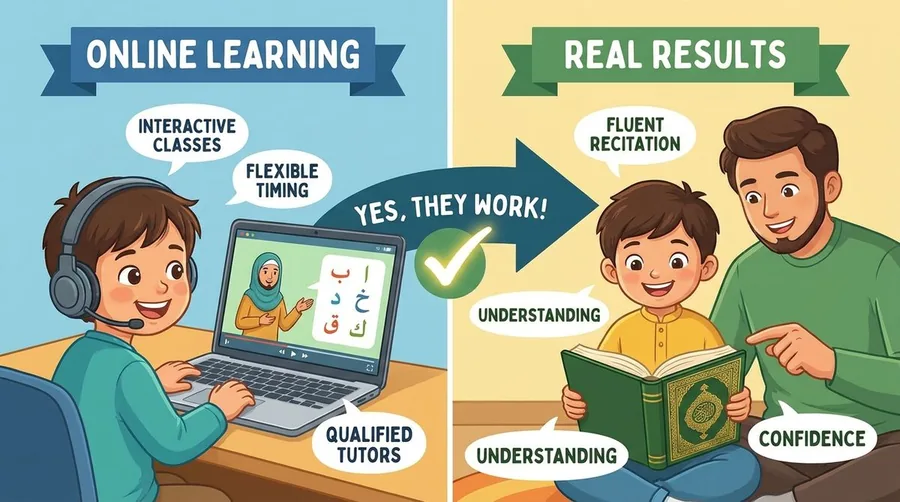
For many Muslim parents living in the USA, Canada, the UK, Australia and other Western countries, finding a reliable Quran teacher nearby can be difficult. Some families don't have an Islamic center close to home. Others juggle busy school, work and family schedules that make regular in-person classes hard.
This is where online Quran classes for kids have become a practical, effective solution. But many parents still ask the same question: do online Quran classes for kids really work?
The simple answer is yes — when classes are structured properly, taught by qualified teachers, and designed around the child's age, level and learning style. At AlQuranClasses, children learn from home through one-to-one lessons, flexible timings and caring teachers who guide young learners step by step.
Why Parents Choose Online Quran Classes for Kids
Convenience is one of the biggest reasons. Families no longer need to drive long distances, work around local teacher availability, or worry about missing classes due to weather, traffic or busy schedules. Your child can attend from the comfort of home — especially helpful where qualified teachers aren't easily available.
Flexibility is another. Between school, homework, activities and family commitments, online Quran classes for kids make it easier to choose times that fit your routine. For working parents, that flexibility makes learning more consistent and less stressful.
How Online Quran Classes for Kids Help Beginners
Many children begin with Noorani Qaida, learning Arabic letters, sounds, pronunciation, joining letters and basic reading rules. Good classes don't rush children into reading the Quran before they're ready — they build a strong foundation first. A beginner usually learns:
- Arabic alphabet recognition
- Correct pronunciation of letters
- Basic Makharij
- Joining letters into words
- Short and long vowels
- Simple Quranic words
- Early Tajweed rules
When children learn these basics correctly, they read the Quran with far more confidence later.
Can Young Children Focus During Online Quran Classes?
This is one of the most common concerns. The truth is that online Quran classes for kids work best when lessons are short, interactive and age-appropriate. Young children don't need long, exhausting sessions — a good teacher keeps them engaged through repetition, gentle correction, encouragement and simple examples. One-to-one classes help even more, because the teacher can slow down and re-explain whenever a child struggles with a letter, sound or word.
Benefits of One-to-One Online Quran Classes for Kids
In group classes, some children feel shy, distracted or left behind. One on One Lessons let the teacher adjust the pace to the child's ability:
1. Personal Attention
The teacher focuses only on your child, correcting mistakes early and building confidence.
2. Flexible Learning Speed
Each child learns at their own pace — quickly or with extra repetition.
3. Better Pronunciation
Because the teacher listens carefully, mistakes are corrected immediately.
4. Comfortable Home Environment
Children often feel more relaxed at home, especially younger ones who may feel nervous in a classroom.
5. Regular Parent Updates
Parents stay involved and can track progress easily.
Are Online Quran Classes Safe for Kids?
Safety matters greatly when children learn online. A trusted academy provides a safe, respectful, professional environment. Before choosing online Quran classes for kids, look for:
- Qualified male and female teachers
- Clear class timings
- One-to-one supervised learning
- Professional communication
- A trial class option
- Transparent course details
- Parent support
At AlQuranClasses, parents can book a free trial class to see how it works before deciding.
What Can Children Learn in Online Quran Classes?
High-quality classes cover much more than basic reading. Depending on age and level, children can learn:
Noorani Qaida
Perfect for beginners starting to recognize Arabic letters and sounds.
Quran Reading
Reading the Quran fluently with correct pronunciation.
Tajweed
The rules of pronunciation, elongation, pauses and articulation for proper recitation.
Hifz
Memorizing selected surahs or following a structured Hifz program.
Islamic Studies
Basic duas, manners, beliefs, prayer and everyday Islamic knowledge.
How Parents Can Help Their Child Succeed
Even the best classes work better when parents create a supportive routine at home:
Create a Fixed Schedule
A regular class time makes Quran learning part of the weekly routine.
Keep the Learning Space Quiet
A peaceful space helps your child focus.
Review Lessons Between Classes
Even 5–10 minutes of revision makes a big difference.
Encourage, Don't Pressure
Children learn better when supported, not forced.
Celebrate Small Progress
Every new letter, word, surah or Tajweed rule is a step forward.
Are Online Quran Classes for Kids Better Than Local Classes?
Both can be beneficial; the better option depends on your family's needs. Local classes work well if you have a qualified teacher nearby and a schedule that allows regular attendance. But online Quran classes for kids are often better for families needing flexibility, one-to-one attention, female teachers, or access to qualified teachers beyond their local area. For many Muslim families in the West, online learning solves a major problem: access.
Why Choose AlQuranClasses?
AlQuranClasses offers online Quran classes for kids built for families who want reliable, flexible, personalized education. Your child can learn Quran reading, Noorani Qaida, Tajweed, Hifz and Islamic Studies, with flexible timings and male and female teachers. Whether your child is just beginning or already reading, we help them move forward with confidence.
Final Thoughts
So, do online Quran classes for kids really work? Yes — when they're consistent, structured and taught by patient teachers. Online learning helps children build a strong connection with the Quran from home, even without a local teacher nearby. For Muslim parents in the USA, Canada, UK, Australia and beyond, it's a practical way to give children Quran education without sacrificing safety, flexibility or quality.