
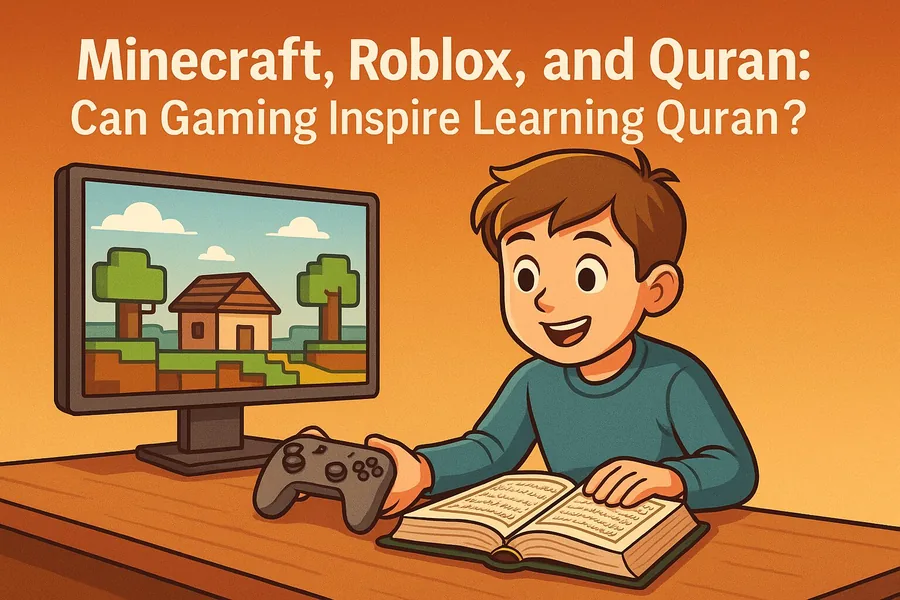
Can Gaming Inspire Learning Quran? It’s no secret that kids today live in a world made of pixels, not pages. They build castles in Minecraft, trade pets in Adopt Me on Roblox, and spend hours completing levels that challenge their creativity and focus. But here’s the question every Muslim parent secretly asks: Can all this gaming ever be a good thing?
Believe it or not, the same tools that make games like Minecraft and Roblox so addictive can also inspire learning Quran—yes, you read that right. What if, instead of fighting screens, we used them to strengthen our children’s connection with the Book of Allah?
Let’s explore how gaming psychology, digital learning, and online Quran classes can work together to create a new generation of curious, motivated, and spiritually grounded learners.
🎮 The Psychology Behind Why Kids Love Games
Before we can understand how gaming can inspire learning Quran, we have to understand why children love games so much. Psychologists call this the motivation loop: every time a child completes a challenge or earns a reward, their brain releases dopamine, the feel-good chemical that drives motivation.
Games like Minecraft and Roblox succeed because they:
- Offer instant feedback (“You built a house!”)
- Create progress systems (levels, rewards, badges)
- Allow creative freedom (you design your world)
- Foster community (you collaborate with others)
Now imagine if Quran learning could feel like that—rewarding, creative, social, and fun.
🌍 The Paradox of the Digital Muslim Child
Our kids are digital natives. Studies show that the average child between 8–12 spends nearly 5 hours a day on recreational screen time. That’s where they explore, learn, and socialize. For them, digital space isn’t “virtual”—it’s real life.
So when parents say, “Put the screen away and read the Quran,” kids often resist—not because they dislike the Quran, but because the method feels disconnected from their world.
This doesn’t mean they don’t want to learn—it means we need to bring the Quran into the world they already love.
💡 Can Gaming Inspire Learning Quran?
Absolutely—and not only can it, but it already is.
The same psychological principles that make video games irresistible—progress tracking, creative freedom, rewards, and social connection—can be used to make Quran learning deeply engaging for modern children. When we understand what keeps kids hooked to Minecraft, Roblox, or any digital game, we can harness those same elements to make Gaming Inspire Learning Quran in powerful, positive ways.
Let’s look at how game psychology and spiritual education can work together to create motivation, connection, and joy.
1. Progress = Motivation
One of the most powerful features of any game is progress. In gaming, children always know where they stand—they earn levels, badges, and rewards. That sense of visible growth keeps them coming back. The same principle can help Gaming Inspire Learning Quran effectively.
Imagine a Quran platform that visually tracks milestones: a glowing badge when a child masters Tajweed rules, a star when they memorize a Surah, or a progress bar that fills up with every completed ayah. This system creates excitement around Quran study, much like reaching the next level in a game.
Online Quran platforms like AlQuranClasses already use this idea through digital dashboards and progress trackers that show how far students have come in their Quran journey.
A 2020 study published in the Journal of Educational Psychology found that visual feedback increased learning persistence by over 40% in children. That means when a child sees progress, they feel progress—and that feeling turns into motivation. By using progress systems inspired by gaming, we can make children see Quran learning not as endless repetition but as a journey of visible growth.
In short, visible achievement makes learning addictive in a good way. And that’s exactly how Gaming Inspire Learning Quran for kids who love digital challenges.
2. Challenge + Reward = Engagement
Games are built around the perfect balance of challenge and reward. Every time a player overcomes a small obstacle, they’re rewarded—through points, levels, or new features. The Quran learning process can tap into the same motivational loop.
When Quran lessons are broken into smaller, achievable goals—like perfecting one letter, mastering a short Surah, or learning the story behind a verse—each success brings satisfaction. Teachers in online Quran classes can make use of digital badges, leaderboards, and virtual certificates to encourage consistency.
These small “wins” trigger dopamine release in the brain, which boosts focus and pleasure. The same neurochemical process that keeps kids glued to their consoles can, with the right design, keep them joyfully reciting and memorizing the Quran.
Some Quran learning programs already use gamified modules that include challenges, quizzes, and real-time rewards. For example, when a student correctly pronounces a verse, a small animation plays, or their progress score increases. These little details might seem minor, but psychologically, they make a huge impact.
That’s the secret behind how Gaming Inspire Learning Quran—it turns repetition into reward, and discipline into delight.
3. Creativity Builds Connection
One reason games like Minecraft and Roblox dominate children’s attention is their freedom to create. Players build entire worlds—each one a reflection of imagination and ownership. Kids love what they create.
To make Gaming Inspire Learning Quran more powerful, we can invite that same creative energy into Quran education. When children express the Quran in creative ways, it moves from being abstract text to personal meaning.
For instance:
- A child can design a “Quran Journal” where they draw or digitally illustrate the stories of Prophets.
- They could build a “Quran Village” in Minecraft, with each house named after a Surah they’ve memorized.
- They could even write short Roblox-style stories based on Quranic values like honesty, bravery, or compassion.
By connecting Quran with creativity, we shift the child’s mindset from learning by force to learning by love. They begin to own their spiritual journey.
Educational neuroscience shows that creative engagement boosts retention by activating multiple areas of the brain—emotional, cognitive, and sensory centers. When learning feels playful and expressive, it sticks.
So the more creative freedom we give, the more Gaming Inspire Learning Quran in meaningful and lasting ways.
4. Community Matters: Learning Together Builds Faith
The social element of gaming is often overlooked—but it’s one of its most powerful features. Whether in Roblox or Fortnite, players thrive on connection. They play in teams, cheer each other on, and share achievements.
Similarly, Quran learning shouldn’t be a solitary journey. Kids learn best when they feel part of a community. That’s why online Quran classes that include small groups or sibling sessions are so effective—they recreate that social motivation within a spiritual framework.
Imagine a group of children logging in from different parts of the world, reciting together, celebrating when one of them completes a Surah, and encouraging one another like teammates in a game. That sense of belonging transforms learning from an obligation into an experience.
A 2019 meta-analysis published in the International Journal of Child Studies found that peer interaction increased motivation and information retention by 60% in young learners. Social connection doesn’t just make learning more enjoyable—it anchors it emotionally.
In essence, gaming teaches us that learning doesn’t have to be lonely. And that’s exactly how Gaming Inspire Learning Quran—by turning spiritual growth into a shared adventure rather than an isolated task.
💫 The Deeper Lesson: When Play Meets Purpose
Games teach discipline without kids realizing it. They fail, retry, strategize, and persist until they win. Isn’t that exactly what Quran learning requires—patience, repetition, and growth?
When we bring Quran learning into the digital space our kids already love, we bridge two worlds: faith and fun. We show them that the Quran isn’t separate from their modern lives—it can exist right inside their tablets, laptops, and hearts.
That’s the miracle of using Gaming Inspire Learning Quran—it helps us transform digital distraction into digital devotion.
💻 Why Online Quran Classes Are the Bridge Between Gaming and Learning
Platforms like AlQuranClasses already combine the best of both worlds—modern interactivity and timeless knowledge. Here’s how:
- Gamified Learning: Teachers use challenges, levels, and visual rewards to motivate kids.
- Interactive Lessons: Quizzes, flashcards, and colorful visuals make learning engaging.
- Global Community: Kids connect with peers and teachers across the world.
- Flexible Timings: Lessons fit naturally into digital routines.
- Holistic Focus: Beyond recitation, teachers help students understand meanings and morals—so Quran learning feels personal and alive.
When kids see Quran lessons on the same laptop where they play games, something powerful happens—they realize Islam belongs everywhere, even in their digital lives.
🌟 Turning Pixels into Purpose
Imagine your child, who once spent hours building virtual houses in Minecraft, now building a deeper relationship with Allah through Surahs and stories. Imagine their online energy channeled into memorizing Surah Al-Fatihah perfectly, or learning the story of Musa (AS) through visuals and interaction.
That’s not a dream—it’s already happening. With the rise of online Quran classes, parents are seeing their children rediscover the joy of faith in the very space they once thought was a distraction.
✨ Conclusion: When Faith Meets Fun
Gaming doesn’t have to be the enemy of faith—it can be the inspiration. When used wisely, the same principles that make games engaging can inspire learning Quran in a way that feels relevant, exciting, and deeply meaningful for this generation.
Our goal isn’t to pull kids away from the digital world—it’s to plant the Quran inside it. Because when the Quran enters their screens, it also enters their hearts.
So if your child loves Minecraft or Roblox, take that as good news—they already have the focus, curiosity, and creativity needed to fall in love with Allah’s Book. They just need the right guide to connect those dots.
Start that journey today with AlQuranClasses —where technology meets tradition, and fun meets faith.